- Tailwind from rising interest rates has been supporting Commerzbank’s top-line
- Strategy 2024 had been on to a great start
- But mBank’s litigation remains a challenge
- We recommend CMZB 4.200% 18Sep2028 Corp (SGD) despite mBank’s situation, which is likely to get called based on the current trend
A
brief introduction of Commerzbank AG
Commerzbank Aktiengesellschaft (“Commerzbank”) is a commercial bank primarily operating in Germany, with an international presence in almost 40 countries. It remains one of the largest banks in Germany, where Commerzbank transacts approximately 30% of Germany’s foreign trade. The operations of the bank are mainly differentiated into the following segments: Private and Small-Business Customers (“PSBC”) and Corporate Clients (“CC”).
With the focus on digitalisation, Commerzbank has about 450 branches across Germany for the provision of client services – an extensive reduction from the 1,000 branches it had prior to COVID-19 pandemic. The digitalisation movement and the reduction in operating branches are part of the planned “Strategy 2024”, a company-wide restructuring programme intended to increase the profitability of the company.
First announced in 2021, the “Strategy 2024” comprises the following core targets – at least 7% Return on Tangible Equity (“RoTE”), reduction of approximately 10,000 full-time equivalents, servicing network of 450 branches and remote advisory centres, exit of 15 international locations, increase in dependency on IT services for operations, and further focus into sustainable milestones for the company. Commerzbank has made adjustments to the targets in “Strategy 2024” along the way, particularly in reference to the Russia-Ukraine conflict and the rising interest rates environment, both with a relatively significant impact on their business.
Of
the operations that Commerzbank possesses, a subsidiary critical for discussion
later is mBank – the fourth largest financial institution in Poland where
Commerzbank owns a 69.3% stake. Most notably, mBank remains embroiled in
drawn-out litigation regarding its Swiss francs mortgage loans. As of 30 June 2022,
Commerzbank has recognised a provision of EUR 940m for risks associated with
the ongoing litigation. For general information regarding the Swiss francs
mortgage loans issue in Poland, please refer to the article by Reuters here.
Commerzbank’s profitability
For the nine months ended 30 September 2022 (“9M22”), Commerzbank reported operating profit of EUR 1,571m, a significant increase from EUR 1,042m in 9M21. The consolidated profit stood at EUR 963m in 9M22, as compared to only EUR 9m in 9M21. While the recent results might look seemingly spectacular due to rising interest rates in 2022, looking into its historical net results in Chart 1, the past profits appear to tell another story.
Chart 1: Net Results (Consolidated Profits)
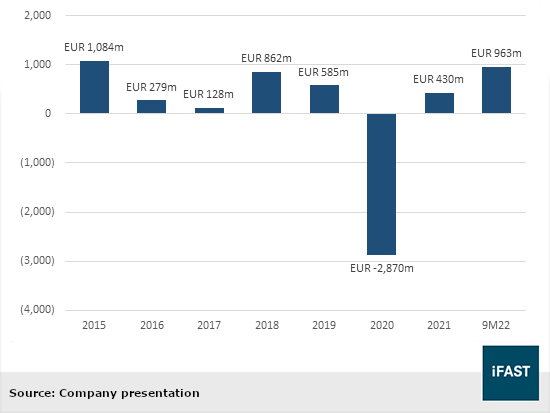
Commerzbank’s key concern is reflected by their goal in “Strategy 2024”, which is ultimately to improve profitability and sustain it. Its financial statements indicate a history of inconsistency in profitability, though in recent years COVID-19 and the Russia-Ukraine conflict undeniably played a big part in this. Setting those aside, such events that are supposedly rare occurrences highlight Commerzbank’s limited ability to cushion such impacts. Taking into account the ongoing litigation, despite being only a segment of its entire business, the uncertainty in mBank’s profits only adds to the problem.
Nonetheless, the effect of the rising interest rates definitely had a positive impact on Commerzbank. Despite the mandated credit holiday in Poland that resulted in a charge of EUR 270m in mBank’s statement, we see an overall rise in the profitability for 9M22 as compared to 9M21. The Polish government introduced the credit holiday in July 2022 to allow the temporary halt of instalments on borrowers’ mortgages for eight months, which has to be split across 2022 and 2023. While it resulted in the abovementioned charge of EUR 270m, the total revenue of EUR 1,886m in third quarter of 2022 (“3Q22”) was able to sufficiently offset this impact.
Commerzbank’s
confidence in “Strategy 2024” is supported by its results, which saw an
increased revenue and a successful reduction in cost. Moreover, the rising
interest rate environment is expected to further support it in the near term.
As such, Commerzbank have been revising their guidance on “Strategy 2024” and
we similarly expect a greater upside potential on the company’s performance.
However, it will require Commerzbank to successfully capitalise on the current
conditions.
The uncertainty in mBank’s future
Diving deeper into mBank, it was the main driver for the increase in net interest income for the PSBC segment in the 9M22. Reflected in Chart 2, its revenue excluding exceptional items (that accounts for the charge due to the credit holiday) stood at EUR 804m in 9M22, accounting for a relatively huge portion of PSBC’s revenue excluding exceptional items of EUR 3,269m in 9M22
Chart 2: Revenue excl. exceptional items in 9M22
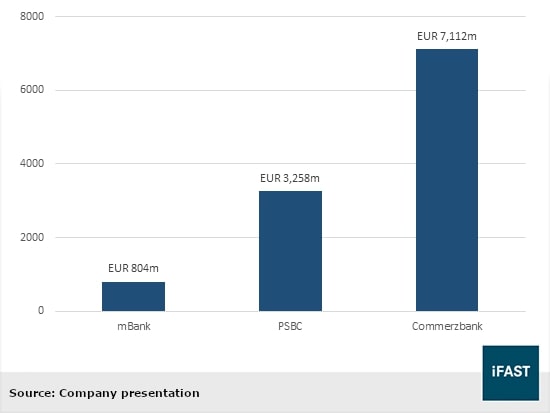
mBank’s statement would look great if we were to exclude the Swiss francs mortgage litigation and the ongoing credit holidays. In 3Q22, excluding the burdens of the credit holiday and the provision for the litigation, the revenue stood at EUR 469m, an increase of 49% over 3Q21.
The actual result inclusive of the burdens though, is at a net negative profit of EUR 528m in 3Q22. In just 3Q22 alone, the provision for the Swiss francs mortgage litigation stood at EUR 477m, against a total provision of EUR 940m before 3Q22. But ultimately, such huge burdens are expected to be temporary and we expect mBank to have a better performing quarter in 4Q22 reflective of the current conditions.
In October, mBank initiated a settlement plan for all clients with active Swiss francs mortgage. The settlement offer would have a loan currency conversion and a reduction in the outstanding principal, with the option to individually negotiate the terms and conditions of the reduction. In addition, for those that convert their mortgage to Polish zlotys, the bank would offer a semi-fixed interest rate lower than the standard interest rate – eliminating foreign currency risk and interest rate risk in the next five years.
What
mBank lacks is clarity of its future where these mortgage loans carry excessive
legal risks. With the settlement plans in place to be offered to clients,
though likely to incur losses from the offer regardless, the clearer path ahead
alongside lesser legal risk is going to be more beneficial for mBank – crucial
for Commerzbank as a whole as it sees to limit the potential downside amidst a
current highly profitable upside situation.
Capital funding and structure
For 2022, Commerzbank targets to issue approximately EUR 7.5b of debt, which as at 9M22, it has issued a total of EUR 5.9b with the majority of EUR 3.5b being mortgage-Pfandbrief (Pfandbrief refers to German covered bonds, typically backed by some form of long-term assets, which in this case the mortgage-Pfandbrief is backed by mortgage). The liquidity reserve stands at EUR 127.2b in the form of highly liquid assets, with the average month-end value of liquidity coverage ratio over the last twelve months at 138.0%, well above the minimum ratio of 100%.
The planned issuance for 2022 is relatively high to replace the ongoing targeted longer-term refinancing operations (“TLTRO”). TLTRO is a form of non-regular, longer-term lending that the Eurosystem has offered to banks since the European Central Bank (“ECB”) took the depo rate negative in 2014, offering longer maturity loans at much cheaper rates. From 23 November 2022 onwards, ongoing TLTRO will have a new interest rate calculation method, resulting in a much higher cost of borrowing than before. ECB intended to push for more repayment of TLTRO with this introduction, to further boost the efforts in reducing inflation back to the targeted 2% range.
For Commerzbank’s CET1 ratio, the current 13.79% as of 9M22 has a CET1 buffer of 435 basis points, to the required level of 9.44%, which is a slight increase from the CET1 ratio of 13.72% as of the second quarter of 2022.
The “Strategy 2024” intends to keep the CET1 ratio above 13.0% across 2022, followed by the target to hit 14.8% by 2024. While Commerzbank remains on track, there is still a significant difference for it to make. Regardless of the target, we believe Commerzbank has had managed its credit profile with prudence, and expect it to remain decent until we see the plans past “Strategy 2024”.
The bond
Commerzbank offers the SGD-denominated CMZB 4.200% 18Sep2028 Corp (SGD). The issue has a call option on 18 September 2023, which the call would be in whole and at par. If the issue is not called, on the same date the rate would reset to the prevailing 5Y SGD SOR plus an initial spread of 1.972%. At an ask price of 96.00, the 4.20% coupon represents a current bond yield of estimated 4.38%.
Currently, the 5Y SGD SOR as of 25 November 2022 is at 3.66%. If interest rate falls from today’s levels, the 5Y SGD SOR would need to fall to 2.228% to allow the coupon to reset at the same 4.2% coupon rate, resulting in the indicative yield to maturity (“YTM”) to be 5.01% on reset. This scenario will be difficult to realise considering the outlook on interest rates, which the rise is expected to last until early 2023.
We think the more likely scenario would be that interest rates maintain at approximately the same level. If the interest rate remains at the current level, where the 5Y SGD SOR is at 3.66%, the indicative yield to maturity is 6.08%. Thus, investors get to have a higher YTM upon reset.
The most idealistic case is the rise in interest rates that would increase the YTM above 6.08% or even induce Commerzbank to exercise the call option, where both remains as a possible scenario. In such a case, the yield to call (“YTC”) will be 9.53%.
Comparing the scenarios, undoubtedly rising interest rates would benefit investors more. For the outlook on the current interest rate, we expect it to remain high. The US Federal Reserve previously announced another 0.75% hike for the fund rates, while suggesting the rates could potentially peak higher and last longer to contain inflation. Given Singapore’s interest rate is closely related to it, we thus expect the interest rates to remain high, at least until the impending reset on 18 September 2023.
Looking at the issues of a similar profile to CMZB 4.200% 18Sep2028 Corp (SGD) – Tier 2 subordinated bonds, issued by a European bank and of similar maturity structure – of the 88 issues year-to-date, 51 issues had gone ahead with an earlier call, with 37 issues remaining unredeemed and to continue to maturity. For Commerzbank itself, it exercised the issuer call option on CMZB 4.875% 01Mar2027 Corp (SGD) on 1 March 2022, instead of allowing the reset at 5Y SGD SOR plus an initial spread of 2.710%. Given that the 5Y SGD SOR was 1.82% on 1 March 2022, the issue would have reset to a lower coupon rate at 4.53%, which did not occur despite being beneficial for the company. With such information in mind, and given the expectations of the interest rates, we think that Commerzbank will call the issue on 18 September 2023.
CMZB 4.200% 18Sep2028 Corp (SGD) is attractive with various conditions – Commerzbank’s ability to capitalise on the current interest environment and to remain on target for “Strategy 2024”, and mBank’s potential settlement to mitigate their legal risk. These major factors look optimistic with the current development in place, but investors ought to remain cautious, particularly as to how mBank’s litigation would develop.
Declaration: For specific disclosure, at the time of publication of this report, IFPL (via its connected and associated entities) holds a position in CMZB 4.200% 18Sep2028 Corp (SGD), and the analyst who produced this report holds a NIL position in the abovementioned securities.
Our podcast series, Yield Hunters, is available on Spotify, iTunes Podcasts and Google Podcasts. We share our thoughts on new bond issues and hold discussions on the fixed income space. Listen to our latest episode below and follow us!